
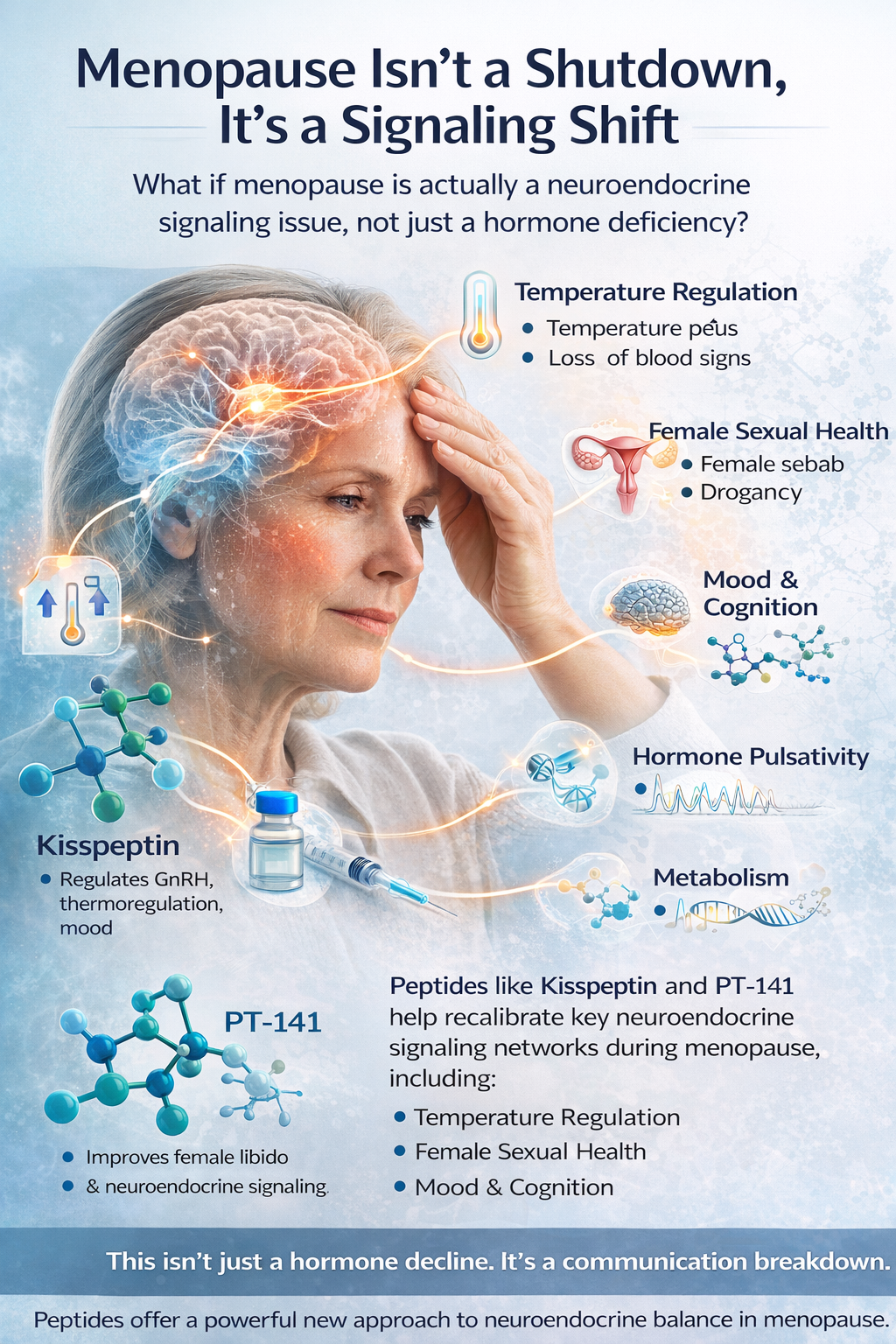
For decades, menopause has been framed as hormonal “loss.”
Low estrogen. Low progesterone. The end of ovarian function.
But what if we’re asking the wrong question?
What if menopause is, in many ways, a neuroendocrine signaling dysregulation problem — not simply a hormone deficiency?
Hot flashes aren’t random.
Sleep disruption isn’t random.
Loss of libido isn’t random.
Even body temperature instability isn’t random.
They are signaling failures.
Thermoregulation & the Hypothalamus
The hypothalamus is the body’s thermostat.
During menopause, fluctuating estrogen levels alter hypothalamic sensitivity — narrowing the thermoneutral zone. Small changes in core temperature trigger exaggerated vasodilation responses → hot flashes.
But the deeper issue?
The upstream signaling networks involving GnRH neurons and kisspeptin pathways become unstable.
This is where the science gets interesting.
Kisspeptin: The Master Reproductive Signal
Kisspeptin is a hypothalamic neuropeptide that regulates GnRH secretion.
GnRH → LH/FSH → ovarian hormone production.
Emerging data shows that kisspeptin neurons are central regulators not only of reproductive hormone release, but also:
• Thermoregulation
• Mood
• Metabolic signaling
• Sexual function
In menopause, the feedback loops that regulate kisspeptin activity become dysregulated. The body isn’t “broken.” The signaling network is unstable.
Restoring proper neuroendocrine signaling may represent a more elegant approach than simply replacing downstream hormones.
PT-141 & Female Sexual Health
Bremelanotide (PT-141) works centrally — not peripherally.
Unlike PDE-5 inhibitors, it activates melanocortin receptors in the brain, modulating sexual desire pathways.
In menopause, libido decline isn’t just hormonal. It’s neurologic signaling attenuation.
Peptides that act at the central nervous system level represent a paradigm shift:
We are modulating desire circuits — not forcing vascular response.
Reframing Menopause
What if menopause is:
Not failure…
Not decline…
Not “the end”…
But a recalibration of hypothalamic signaling networks?
Women’s bodies are not malfunctioning.
They are transitioning through altered neuroendocrine communication.
And when we look at menopause through the lens of:
• Kisspeptin pathways
• Melanocortin signaling
• Thermoregulatory modulation
• Metabolic adaptation
The conversation changes.
The Next Generation of Menopause Care
Instead of:
“Here’s estrogen, good luck.”
We start asking:
• How is hypothalamic signaling functioning?
• How is GnRH pulsatility affected?
• What central pathways are under-signaling?
• How do we restore signaling precision?
This is precision neuroendocrinology.
And peptides may be one of the most elegant tools in that evolution.
Menopause is not a deficiency story.
It’s a communication story.
And communication can be restored.

Leave a comment
This site is protected by hCaptcha and the hCaptcha Privacy Policy and Terms of Service apply.